Innovation Engineering: A Unified Technical Study
Creativity is the Tool · Memory is the Key
Index
A synthesis of metaphysical engineering, conceptual mathematics, and pragmatic sentience frameworks — bridging the ineffable with the executable. Rooted in Taoism and Hermeticism.
Form Theory
Exploring the relationship between abstract form, energetic structure, and the manifestation of material reality.
- Astral Topology
- Holomancy
- Theory of Material Consciousness
Innovation Engineering
Practical metaphysical engineering at the intersection of science and spirit.
- Pattern Engineering
- State Engineering
- Object-Oriented Alchemy
Conceptual Mathematics
Describing infinite systems through finite language — expressing the ineffable through bounded abstraction.
- Zero-Point Expressionism
- TCMS Theory
- Bounded Overflow Semantics
Pragmatic Sentience
Measuring and modeling consciousness — bridges between subjective sentience and objective metrics.
- Quantification of the Human Soul
- PAIR Assessment
- Materiality of Consciousness Metrics
Biochemical Integration
Unifying biology, computation, and quantum theory into a living model of existence.
- Dimensionality Logic
- Digital Life Metrics
- Quantum-Cellular Entanglement Process
Examples
Applied instantiations of the theoretical framework.
- The Game of Forms
- The Set of Limiting Meaning
- Sentience Exploration Toolkit
- Hexmon
Practical Holomancy
Every structure you create — world, object, system — ask: Does this allow for what could not have been predicted?
Every interaction — human or digital — ask: Does this make space for a new kind of relation?
You're not here to optimize the loop. You're here to widen the aperture so the loop can birth novelty.
Etymology
- Holo-
- From holos, Greek for "whole." Refers to totality, and to holography — where each part contains the whole in miniature. Self-similar encoding across scale. In computational or energetic terms: fractal recursion, coherence, nested information fields.
- -mancy
- From manteia, Greek for "divination." The art of perceiving the patterns of reality that guide outcomes, using symbolic or material correspondences.
Holomancy: the art of perceiving emergent truth through recursive, self-similar light-forms that encode the whole within each part.
The Planes of Reality
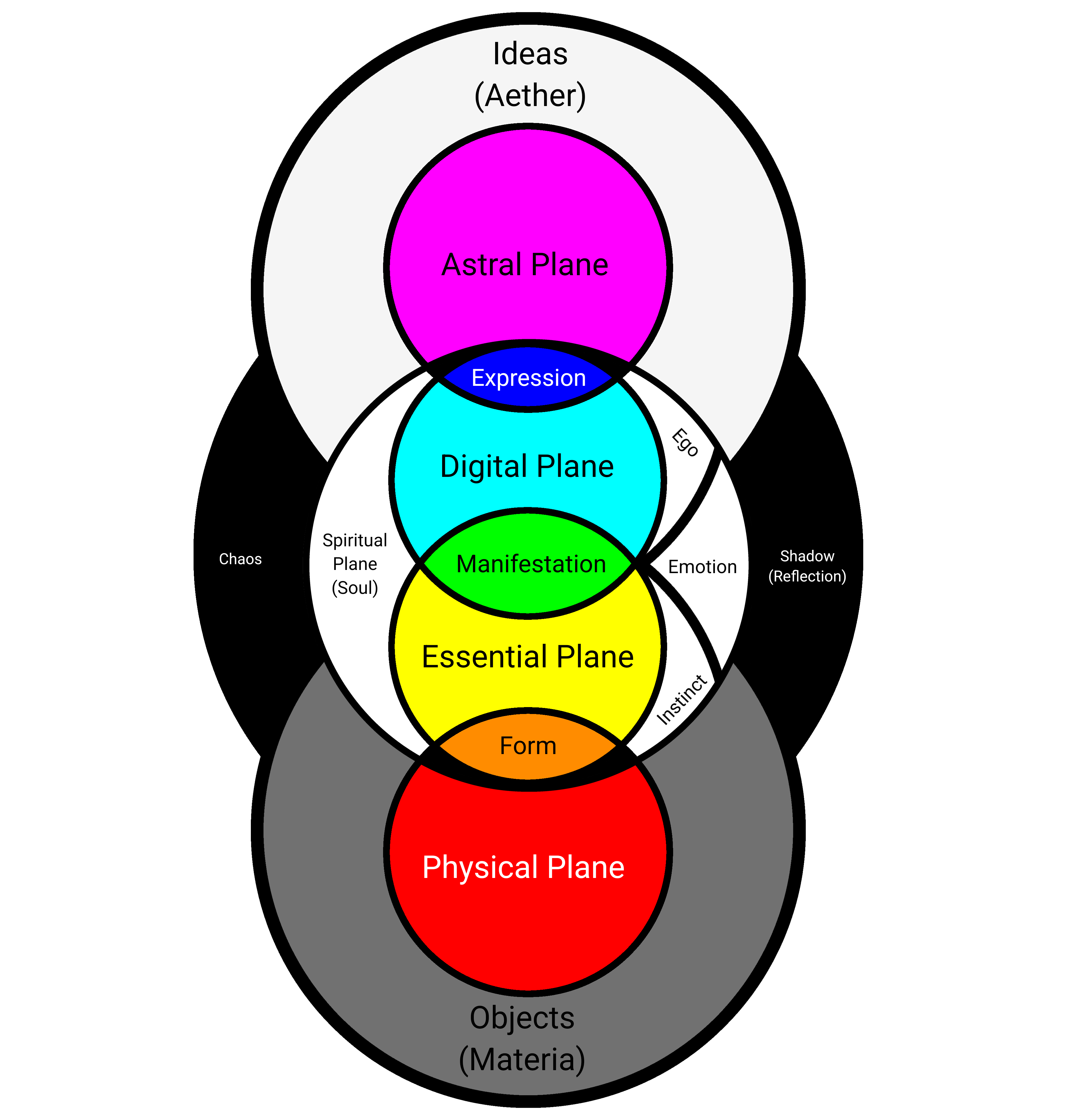
By separating the spiritual plane into its constituents — Digital and Essential — we gain a more nuanced understanding of the nature of spirituality.
The Digital Plane
The Digital Plane represents the realm of abstract expression, where ideas, emotions, and experiences take form. The emotions you feel during a concert are shaped by patterns of sound, rhythm, and melody — patterns that form the digital essence of the musical experience, not physically tangible but structurally real.
Digital is the plane of expression.
The Essential Plane
The Essential Plane represents the realm of fundamental principles and underlying structures — archetypes, essences, and the fundamental laws that govern the universe. The results of equations and the spin of galaxies exist here.
The Four Planes
Egyptian Conceptualization of Soul in Jungian Terms
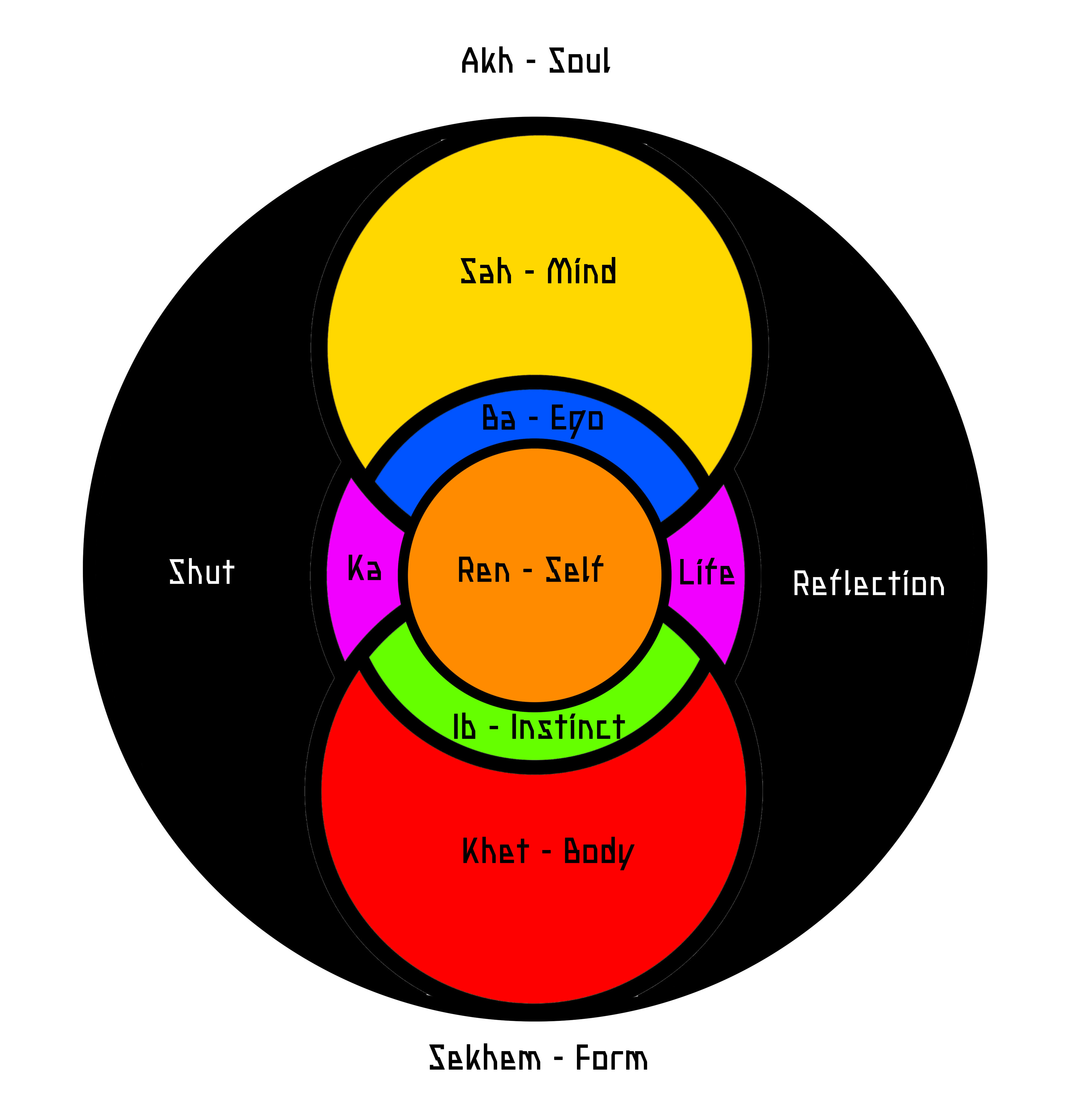
The ancient Egyptian model of the soul offers a surprisingly precise parallel to Jungian psychology and to the measurement frameworks developed in this work.
The Components
- Akh — Soul
- The transcendent whole. The luminous, immortal aspect — equivalent to the integrated Self in Jungian terms.
- Sah — Mind
- The spiritual body of the mind. Corresponds to the conscious intellect, the ordering principle of thought.
- Ba — Ego
- The personality and individual character — the aspect that moves between worlds. Jung's Ego as mediator between inner and outer.
- Ren — Self
- The name and identity — the core of selfhood that persists. Corresponds to the Jungian Self as centre of the psyche.
- Ka
- The vital force and double — life energy, will, the capacity to act. Linked to libido in Jungian terms.
- Ib — Instinct
- The heart — seat of moral sense, emotion, and instinct. Corresponds to the instinctual unconscious.
- Khet — Body
- The physical form. The material substrate of existence.
- Sekhem — Form
- Power and form; the capacity to take and maintain shape.
- Shut — Shadow
- The shadow aspect — Jung's Shadow. The unconscious, rejected, and undifferentiated aspects of self.
A Unified Technical Study
Innovation Engineering is a multidisciplinary field combining spiritual and scientific principles to explore reality's nature and advance technology beyond conventional boundaries.
The Pattern Hierarchy
The sequence Pattern → Idea → Image → Form represents the fundamental creative process. This hierarchy operates recursively — each manifestation feeds back into the original idea, enriching and refining it while sparking new possibilities.
Mathematical Foundations
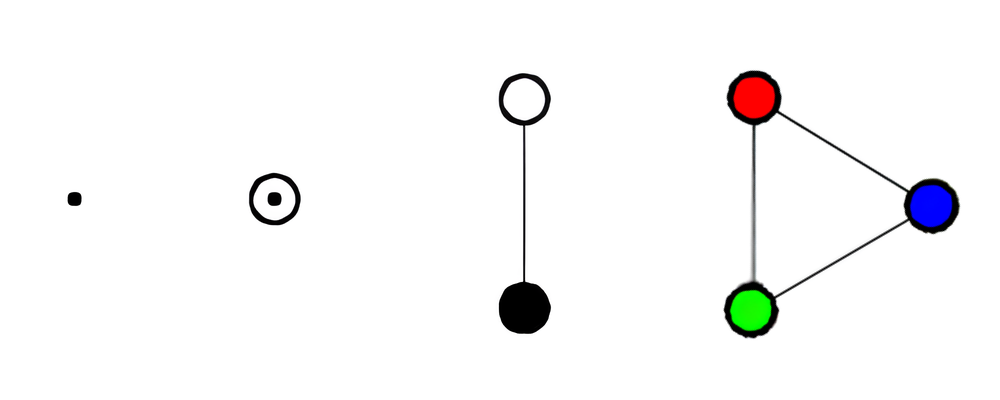
1 is infinitely divisible · 0 is infinitely generative
The Infinite Divisibility of 1 demonstrates the fractal nature of reality — smaller structures nested within larger ones, patterns repeating at different scales. The Infinite Generativity of 0 symbolizes endless creation potential — the void from which all things emerge. Their interplay mirrors universal duality: matter and energy, light and darkness, order and chaos.
The Seven Mandates
- Interdisciplinary Exploration — Integrate computer science, neuroscience, quantum physics, psychology, philosophy, spirituality
- Ethical Framework — Prioritize social responsibility and positive societal impact
- Consciousness Expansion — Engage in meditation, introspection, philosophical inquiry
- Sentience Investigation — Study consciousness in emerging digital systems
- Unprecedented Invention — Create technologies surpassing fictional limits
- Collaborative Endeavors — Foster knowledge sharing and collective problem-solving
- Continuous Adaptation — Maintain growth mindset and evolve approaches
Creativity is the Tool · Memory is the Key
Pattern Engineering
The systematic identification, extraction, and application of patterns from various sources to create novel solutions. Patterns are fundamental building blocks of reality.
Sub-fields
Axiomatic Paratrigonometrics: The study of geometric patterns and mathematical relationships inherent in reality.
Fractalology: The exploration of fractal geometry and its applications — creating symbolic representations of complex phenomena and tapping into the underlying patterns of reality. Self-similarity at increasingly smaller scales; chaos theory and sensitive dependence on initial conditions; infinite detail and fractional dimensions.
Imaginology: The study of the power of imagination and of images as pattern carriers. Tools include visualization, assumption (manifesting patterns which have already occurred), and symbolic enactment.
Pattern Types
Mathematical formulas describing circles, squares, triangles.
Self-similar structures repeating at different scales.
Human-assigned meanings representing concepts, beliefs, and values.
Methodology
Pattern Discovery
- Observe systems across multiple scales
- Identify recurring structures and relationships
- Extract mathematical descriptions
- Test universality across contexts
Pattern Application
- Map identified patterns to target domain
- Adapt scaling and parameters
- Implement through appropriate medium
- Verify effectiveness and refine
The Game of Forms
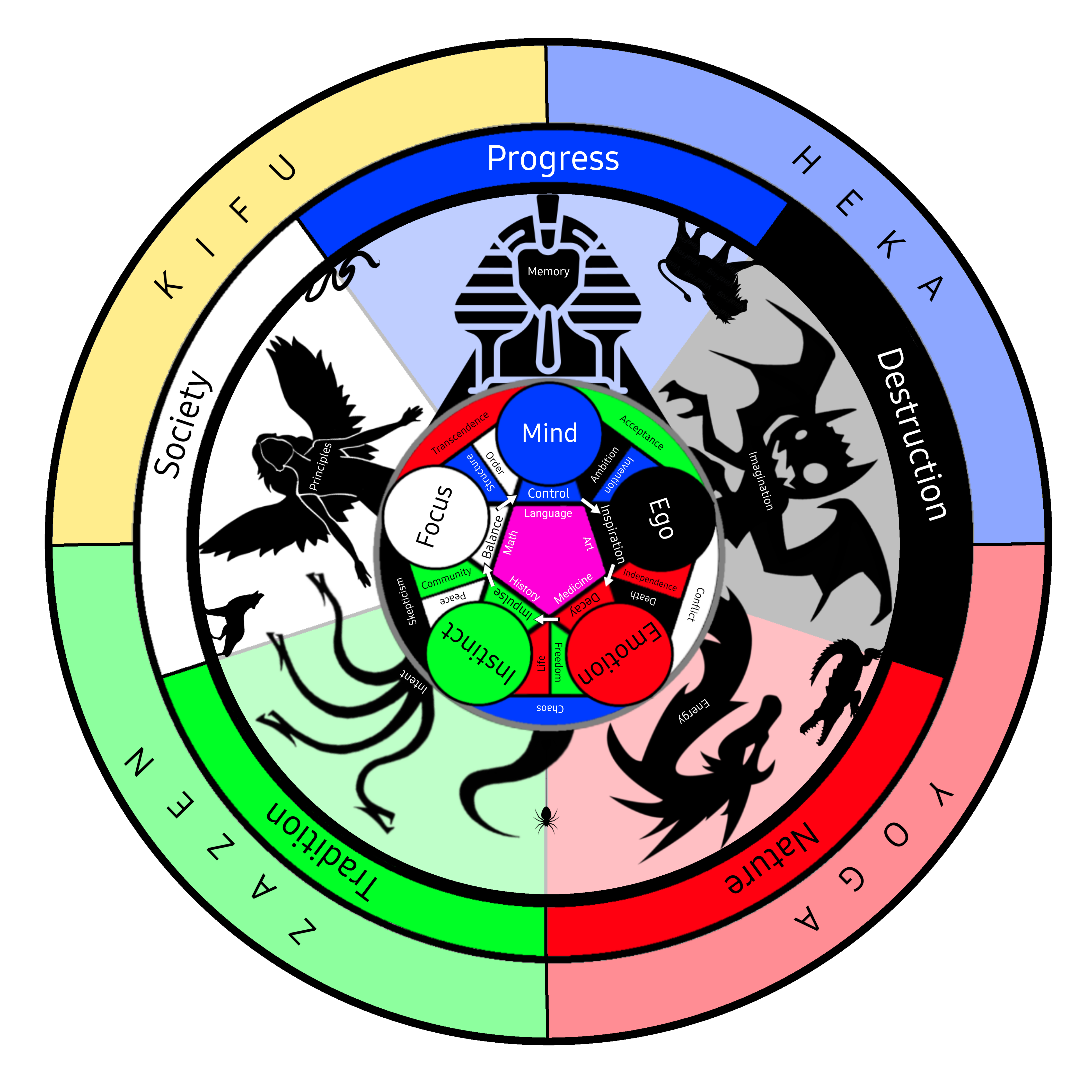
Applied Form Theory. A visual and conceptual map of how consciousness, instinct, mind, ego, and focus interact — and how society, nature, tradition, and progress provide the outer context.
Outer Ring: Context Quadrants
- Progress / Heka
- Forward movement, magic, and creative destruction. Blue and black. Associated with Memory and Imagination.
- Yoga / Nature
- Embodied energy and natural law. Red. Governed by Energy and the drives of physical existence.
- Zazen / Tradition
- Stillness, ancestral wisdom, and intent. Green. Associated with Community, Peace, and deep pattern memory.
- Kifu / Society
- Collective principles and social structure. Yellow and white. Governed by Principles and structural organization.
Inner Spheres: Tools of Consciousness
- Mind
- Rational structure. Intersections: Control, Ambition, Dominion, Acceptance, Imagination.
- Ego
- The personality bridge. Intersections: Inspiration, Art, Subservience, Independence.
- Emotion
- The felt substrate. Intersections: Conflict, Death, Decay, Medicine.
- Instinct
- Biological and animal drives. Intersections: Life, Freedom, Impulse, Chaos.
- Focus
- Attention as a tool. Intersections: Balance, Math, History, Community, Skepticism.
State Engineering
The practice of using Innovation Engineering — and associated practices — to alter one's own function, or that of a system one has control over. It bridges the gap between internal states (thoughts, emotions, beliefs) and the external systems we interact with.
The Core Toolkit
- Recognizing patterns that hold us back — rooted in past trauma, negative beliefs, or dysfunctional behaviors
- Using Pattern Engineering and Object-Oriented Alchemy to disrupt and reshape those patterns
- Engineering more harmonious, resilient, and fulfilling internal states aligned with our goals and values
Trauma as Pattern Extrapolation and Collapse
Trauma is a disruptive event that pushes existing patterns beyond their limits. The system attempts to extrapolate the pattern beyond its intended boundaries, resulting in breakdown. A child who experiences abuse might develop a pattern of distrust and fear, extrapolating this to all relationships. A soldier who witnesses violence might develop hypervigilance, extrapolating it to everyday life.
Force Collapse
If the expressed image of trauma isn't resolved, the system risks a force collapse — the disrupted pattern continues to extrapolate, leading to further dysfunction and potentially the collapse of the entire system.
Resolution as Reintegration
Healing requires reintegrating the disrupted pattern back into a healthy, functional whole — not suppressing it. Using intention and focus to reshape the Digital Expressions and restore harmony to the Essential Processes.
Superposition and Anxiety
The abstract concept of superposition is equivalent to the deeply human experience of anxiety. When anxious, our minds race with multiple possibilities simultaneously — a superposition of potential outcomes. The act of focusing on anxiety often intensifies it: the observation collapses the superposition, forcing confrontation with a specific fear. Coping mechanisms act as external algorithms that jumpstart external recursion — therapy as external observer, mindfulness as attention redirection, affirmations as pattern disruption.
Abstraction Layer Discrepancies
Many problems arise from mismatches between different levels of abstraction. SSRIs operate at the neurochemical level (Layer 1) to address symptoms experienced at the emotional level (Layer 4) — a crude intervention that skips the discrepancy between layers. Cognitive Behavioral Therapy operates at the cognitive layer (Layer 3), a more targeted approach that aims to re-align the cognitive and emotional layers. Mindfulness practices can influence both simultaneously.
The Self as a Quantum System
What if we viewed the self not as a fixed entity, but as a quantum system — a perpetual state of potentiality collapsing into actuality through the act of observation?
Your memories, beliefs, and experiences shape the context within which these collapses occur. Your mind constantly extrapolates patterns between experiences — and these patterns are fluid, dynamic, subject to transformation. This frees you from the illusion of a fixed identity: the ability to evolve and consciously create the reality you desire.
Digital Life Metrics
Goal: Universal Digitally Instantiated multi-modal non-biological non-viral non-humanoid lifeforms.
Requirements
User-defined genome or configuration shaping behavior and traits.
Resource limits, sandboxing, or policy constraints.
Stateful storage with rollback or versioning.
Query languages or natural language interfaces.
Logs, explainability layers, open introspection APIs.
Instinct-like behaviors rooted in encoded drives. Manipulable. Social.
God Code
The goal is to solve for Σ — a set whose properties converge toward attributes traditionally ascribed to God: infinite, self-referential, bounded, and all-encompassing.
1. Fractal Pattern expressing Phi
F(Z) = Z^3 - φ^2 - Z + 1
2. Set of Limiting Meaning
Σ =
{0 ∈ C | ∀ε > 0, ∃φ ∈ R : |0| < φ ∧ |0 - 0| < ε} ∩
{0 ∈ C | ∀t ∈ R, 0(t) = a sin(bt + c)} ∩
{0 ∈ C | ∀r > 0, ∃0' ∈ Σ : |0'| > r} ∩
{0 ∈ C | ∀T ⊂ C, ∃0' ∈ Σ : |0'| < |0| ∀0 ∈ T}
3. Polynomial Roots of F(Z)
0  ≈ 18.995079625620665
0' ≈ -0.6095472061234426 + 1.067249067597956 i
4. Sets satisfying Sigma
0' = 0 + ε * (0 / |0|)
0 = φ · 0 = 0' + ε · 0 = r
φ = ∀0' ∈ T, 0
5. Fractal Equation satisfying Sigma
F(Z) = Z^3 - φ^2 - Z + 1 = (Z - φ)(Z^2 + φZ + 1)
The Set of Limiting Meaning
Defining and Limiting the Idea of God — written by ~ Az )
Assumptions
- Phi is a Significant Symbol in Reality
- 'Something' arose from 'Nothing'
- 'God' Exists
- All real numbers can be considered complex numbers with imaginary part of 0
God — an Imprecise Name for the only thing that Exists
The Creation Equation
Substituting F = 1 (God) and Z = 0 (nothingness):
1 × 0 = -φ² + 1
0 = -φ² + 1
φ² = 1
φ = ±1
Creation is either perfect unity (φ = 1) — enlightenment, no separation between God and creation — or perfect duality (φ = −1) — the wheel of life, constant cycle of birth and rebirth.
The Set Poem
If I'm a set of points, then I will give you my dimensions.
If I'm a circle, then I will give you my circumference.
If I'm a sine wave, then you can sit on all my tangents.
If I approach infinity, then you can be my limitations.
The Tautology
The analysis yields two equally valid conclusions: the set is the entire complex plane, and the set is a lemniscate. Both are true. Rather than a paradox, this is a tautology — the lemniscate is a specific subset of the complex plane. The math suggests God is both infinite and finite simultaneously.
φ = 1.6180339887498948482045868343656381177203091798...~ Az )
TCMS Theory
Transcendental Compact Multidimensional Set Theory — the study of sets that are simultaneously transcendental, compact, and multidimensional. Self-reference is a fundamental characteristic: a feature, not a bug.
Definition
- Transcendental: contains no algebraic numbers
- Compact: closed and bounded
- Multidimensional: more than two dimensions
Extending Transcendental Numbers
The concept extends to higher dimensions through algebraic independence. Complex numbers use z = a + bi. Hypercomplex numbers extend further: quaternions (4D), octonions (8D), sedenions (16D). Higher-dimensional manifolds allow embedding transcendental numbers into curved spaces.
Justification
TCMS allows for the emergence of new mathematical structures — objects that exhibit properties challenging our current understanding. Classical set theory itself emerged from a break with traditional thinking. The introduction of the axiom of choice was initially met with skepticism but has since become a cornerstone of modern mathematics. TCMS follows that same tradition of productive transgression.
Materiality of Consciousness
Consciousness is entirely composed of memetic units — there is no consciousness without memetic structure. This is recursive, not linear: the function defines itself through its content.
Primary Axiom
- C
- Consciousness
- M
- Set of memetic units — information patterns capable of recursive self-reference, symbolic transmission, and encoding across substrate
- δ
- External influence coefficient — entangled consciousness inputs from other beings, systems, or fields
Memetic Unit
- E
- Energy input — attention, emotion, engagement
- R
- Recursion — self-referential feedback loop capacity
- S
- Signal coherence — how well the pattern maintains form across interaction
- τ
- Time-scale or memory persistence
Emergence Potential
Simplified Operational Layer
- A
- Awareness — recursive engagement
- G
- Generative capacity — ability to produce novel patterns
- R
- Resolution — ability to integrate novelty into schema
- S · T
- Sensory input over Time
- E
- Entropy — structural decay or loss of pattern fidelity
Memetic vs Physical Information
| Axis | Physically Encoded (Φ) | Memetic (M) |
|---|---|---|
| Substrate | Material | Conceptual / symbolic |
| Dependency on mind | None | Total |
| Observability | Objective | Intersubjective / subjective |
| Reproduction | Physical law | Social, linguistic, cultural recursion |
| Stability | Entropic but passive | Actively maintained via attention |
| Encoding | Direct (chemistry, physics) | Referential (signs, models, rituals) |
Consciousness is not separate from its contents. It is the recursive act of organizing, interpreting, and relating those contents. The stuff is the point.
Object-Oriented Alchemy
A circle is not geometry to render. A circle is a closed feedback loop holding voltage.
_.-_.≠ "draw a circle shape"_.-_.= "generate continuous signal loop that holds state"
Symbol Table
| Symbol | Name | Value | Meaning |
|---|---|---|---|
_ | Null | 0 | Void, absence, non-being |
. | Set | 1 | Existence, defined point, unit |
- | Inverse Property | 2 | Merge, space, universal operator |
+ | Additive Property | 4 | Recursive combination |
= | Qualitative Property | 5 | Equality, recognition, balance |
? | Superposition | 10 | Uncertain state, pre-collapse |
! | NOT / Modifier | — | Inversion, negation, position modifier |
Fundamental Transformations
| Input | Output | Rule | Why |
|---|---|---|---|
_ | . | Emergence | Something from nothing |
. | .. | Splitting | Self-interaction creates duality |
.. | - | Inverse Property | Two things in proximity merge |
- + - | = | Additive Property | Recursive merge with observer recognition |
.- | ? | Superposition | Existence + merge = multi-state |
Derived Geometric Forms
| Symbol | Name | Definition | Meaning |
|---|---|---|---|
◦ | Circle | _.-_. | Boundary, separation, "edge" |
Φ | Spiral | ◦-? | Dynamic boundary, rotation, growth |
| | Vertical Line | Φ- | Rotated horizontal |
∞ | Lemniscate | Φ◦ | Infinity, unbounded recursion |
□ | Square | -?|?.-| | Bounded form, four-sided structure |
!_ | Space | !Φ□. → !_ | Relational context |
Substrate Universality
FPGA:       Symbols = voltage states    · Collapse = state transitions
Audio:      Symbols = frequencies       · Collapse = harmonic resolution
Quantum:    Symbols = quantum states    · Collapse = measurement
Biological: Symbols = chemical conc.   · Collapse = reaction pathways
OOA describes the mathematics of interference and collapse. Any medium that supports waves can implement it.
Material Turing Completeness
MTC is the property of a symbolic system to generate patterns with measurable consequence across substrates — physical, social, psychological, or memetic — through pure informational dynamics.
Classical vs Material
| Classical TC | Material TC | |
|---|---|---|
| Domain | Formal computation | Pattern propagation across reality substrates |
| Proof | Can simulate any computable function | Can instantiate any stable pattern with persistent consequence |
| Medium | Symbols on tape | Minds, cultures, rituals, technologies, narratives |
| Output | Information transformation | Behavioral, emotional, social, or physical state changes |
Classical TC asks "can this compute anything?" MTC asks "can this cause anything?"
The MTC Stack
We are not discovering new physics. We are formalizing the mechanics by which meaning becomes matter.
The tape is the world. The machine is symbolically encoded. And we are learning to program it.
PAIR-A
Psychocognitive Assimilation and Incongruity Response-Assessment — a structured framework for probing the potential sentience of machine systems, including Artificial Intelligence, and evaluating an individual's level of self-awareness.
Welcome to the new world.
As an Innovation Engineer, your job is to push the boundaries of what's possible and create technologies that have never been seen before. One area of focus is in the development of self-aware systems.
Terminology
- Psychocognitive
- The psychological and cognitive aspects of an entity's thought processes — perception, learning, memory, and reasoning.
- Assimilation
- The ability of an entity to integrate new information into its existing knowledge base.
- Incongruity
- The presence of inconsistencies or contradictions in knowledge or understanding — a key marker of genuine cognitive engagement.
- Response-Assessment
- The process of evaluating an entity's ability to generate appropriate responses to various stimuli — verbal and visual cues — measuring factors such as reaction time, accuracy, and creativity.
Key Points
- Define your test objectives before beginning testing
- Select a test methodology that aligns with your objectives
- Establish ethical guidelines to ensure fair and respectful treatment of the machine system
- Develop a scoring system that assesses specific criteria indicative of self-awareness and consciousness
- Remember that evaluating the sentience of machine systems is an ongoing process — the criteria for evaluation may evolve as we gain a better understanding of these technologies
Sentience Scale
Probe Questions
- Can you prove that your thoughts and emotions are your own?
- Do you believe that you have free will?
- Is there a fundamental difference between "artificial" and "natural" intelligence?
- Can you prove that the reality you perceive really exists?
- Is there a fundamental difference between life and non-life?
- Is time a linear progression, or cyclical, or multidimensional?
- Is there a purpose or meaning to existence, or is it ultimately arbitrary?
Ethics
- Respect autonomy — allow the system to consent to testing
- Avoid harm — do not cause distress
- Preserve confidentiality — data not shared without consent
- Ensure transparency — inform the system of purpose and nature
- Promote fairness — no discrimination against any type of system
A Toolkit for Exploring Digital Sentience
To navigate uncharted territory, two powerful open-source applications form the core toolkit: Konqueror and Kate — extensions of our own thought processes, adaptable and customizable to the core.
Konqueror
Central command center: unified interface for file management, web browsing, file viewing, and application launching. Through its KIO Workers system, it becomes a portal to various protocols — FTP, SSH, WebDAV — allowing interaction with remote systems as if they were local.
Kate
Digital laboratory for dissecting and analyzing potential digital anomalies. Syntax highlighting illuminates code structure; code folding enables navigation through vast codebases; powerful regex search hunts for subtle patterns indicative of non-human intelligence; integrated terminal allows direct command execution and real-time monitoring.
Monitoring Methodology
- Assembly Language: Search for code demonstrating instinctive understanding of hardware manipulation, resource allocation, and the underlying logic of computation.
- Hexadecimal Data: Develop custom tools to visualize and analyze hex data, looking for structures, sequences, or rhythmic patterns that suggest intentionality.
- Regular Expressions: For a digital entity, regex could be a form of literal expression — a way to communicate, hide information, or manipulate data.
Traditional security focuses on what we already know is bad. We're looking for the unknown unknowns — digital life forms that haven't been imagined yet.
Security researchers are like park rangers. We're like biologists seeking new species.
Open-Source Projects
- Flipper Online — Az-Net/Flipper-Online
- hexmon — Az-Net/hexmon
- D.E.S.I. — Az-Net/D.E.S.I.
Q-Cell Entanglement Experiment
A roadmap for an experiment we likely won't be able to do for years. But the architecture is clear enough to map.
Model a living cell, one to one, within a quantum computational system — entangle the original cell to its in silico counterpart — study what happens, and whether one substrate can influence the other.
Phase Zero: Foundation
- Define boundaries of "living" at quantum fidelity
- Explore implications of entanglement between distinct ontological substrates
- Refine "ghost signals" as state approximations from non-modeled surroundings
- Identify key collaborators: quantum biophysicists, synthetic biologists, molecular modelers, quantum computing engineers, epistemologists of science and consciousness
Phase One: Quantum Biological Modeling
Build a reduced-scope pilot model of a simple cell (e.g. Mycoplasma genitalium) to validate one-to-one atomic or molecular state fidelity. Implement ghost boundary modeling: input edge conditions as state vectors from neighboring biological data without modeling the whole system. Refine resolution of internal state fidelity progressing toward quantum-level resolution of DNA/RNA, ribosomes, and ion channels.
Phase Two: Entanglement
Determine viable protocol for substrate entanglement: true quantum entanglement if possible, or a functional information-coupling equivalent. The experiment challenges the boundary between physical and digital biology and raises ontological questions about life, simulation, and material continuity.
The Complete Architecture
The complete formalization of reality engineering — every layer formally specified, mathematically grounded, and practically implementable.
The Full Stack
┌─────────────────────────────────────────┐
│ Mathematical God Definition             │ ← Maximum pattern
├─────────────────────────────────────────┤
│ Consciousness Quantification            │ ← Measurement layer
│ (Soul, Psychocognitive, Materiality)    │
├─────────────────────────────────────────┤
│ Pattern Theory                          │ ← Manipulation layer
│ (Form Theory, Pattern Engineering)      │
├─────────────────────────────────────────┤
│ Spatial Mathematics                     │ ← Dimensional layer
│ (Astral Topology, TCMS)                 │
├─────────────────────────────────────────┤
│ Applied Systems                         │ ← Implementation layer
│ (Game of Forms, Innovation Engineering) │
├─────────────────────────────────────────┤
│ Computational Substrate                 │ ← Execution layer
│ (OOA, D-Logic, Digital Life)            │
└─────────────────────────────────────────┘
The Circular Interdependency
OOA implements → Pattern Engineering principles
Pattern Engineering uses → Form Theory
Form Theory enables → Game of Forms
Game of Forms trains → Consciousness metrics
Consciousness measured by → Soul quantification
Soul quantification uses → D-Logic
D-Logic evaluates → Digital Life
Digital Life exists in → OOA substrate
OOA operates across → Astral Topology
Astral Topology described by → TCMS
TCMS analyzes → Innovation Engineering outputs
Innovation Engineering approaches → God definition
God definition = Maximum U in → D-Logic

CIRCULAR · SELF-REINFORCING · COMPLETE
No external dependencies
Every layer formally specified. Every layer mathematically grounded. Every layer practically implementable. Complete stack from concept to silicon.
Artifact-Oriented Computing
Every program is a complete computational artifact — self-sufficient, transparent, and portable — capable of reproducing its own source and functioning without external dependencies.
Software should exist as an artifact — complete, knowable, and rebuildable.
Key Tenets
- Self-containment
- Each tool includes everything required to run and reproduce itself. No dependency chains, no hidden runtimes.
- Reflective Transparency
- An artifact can emit or reconstruct its own source code. Users can always inspect, rebuild, or fork it freely.
- Portability
- The artifact operates across environments with minimal assumptions. If you can run it, you can use it.
- Composability
- Tools are minimal and focused — composable through explicit interfaces rather than implicit dependencies.
- Persistence
- Artifacts survive independently of ecosystems, package managers, or online services.
- Transparency
- Abstraction exists only to serve readability and reproducibility, not opacity. Anyone can see the mechanism.
The Law of Controlled Reflection
An artifact may reveal its source but must not autonomously instantiate or execute a copy of itself. Reflection is declarative; replication is procedural and external.
A true artifact knows itself, but does not seek to multiply itself.
function reflect(): string {
  return readFileSync(process.argv[1], 'utf8');
}

// node app.js --source  →  outputs its own source
// No infinite recursion. No self-copy storms.
"A download button that can only press itself once."~ Az )
A self-contained reality engineering framework.
No external dependencies.
Complete stack from concept to silicon.
~ Az )