d. 01 Feb 1851
aged 53
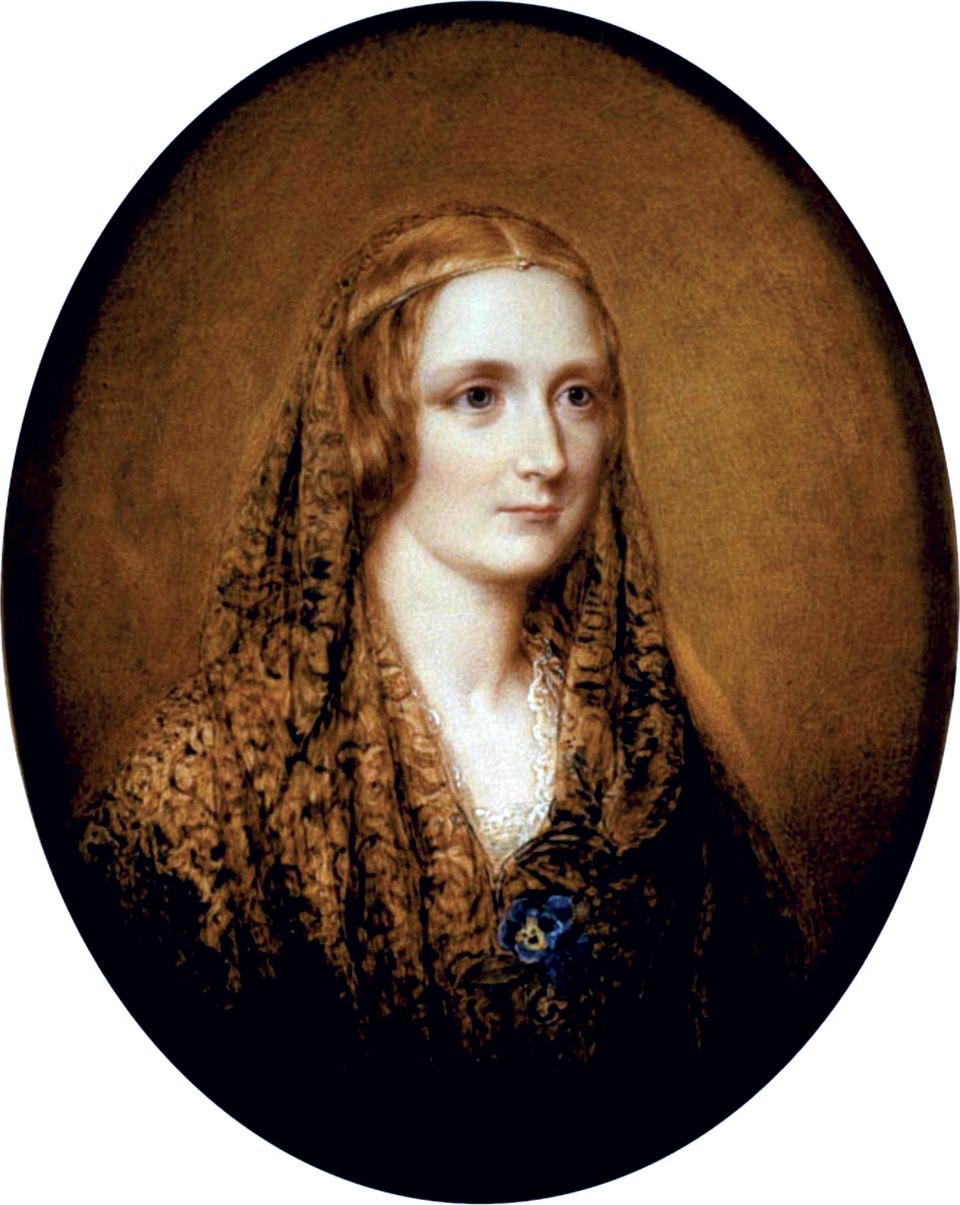
Mary Shelley wrote Frankenstein; or, The Modern Prometheus in 1818, at the age of eighteen, and in doing so produced the founding document of this entire lineage. The novel did not merely imagine artificial life — it established the complete philosophical and ethical framework that everyone from Turing to the Tamagotchi engineers would spend the next two centuries working inside. Before computers, before genetics, before robotics, it posed the questions that still have no settled answer: what obligations does a creator owe to the thing it creates? What happens when the made being exceeds the maker? Can a constructed mind have moral standing? Is suffering, in a being that was built, any less real?
Shelley wrote Frankenstein at the Villa Diodati during the famous ghost story competition with Percy Shelley, Lord Byron, and John Polidori — a gathering of some of the most electric minds of the Romantic era. She was the youngest person in the room, and she produced the only work that endured. The novel's specific insight — that Victor Frankenstein's greatest crime is not the creation but the abandonment, not the making but the refusal to acknowledge what he made — is the moral axis every subsequent artificial life narrative has orbited. It is also autobiographical: a book about a created being who wanted only to be loved and recognized, written by a woman who spent her life being neither.
Her other works are almost as significant and almost entirely forgotten: The Last Man (1826) is a novel of civilizational pandemic collapse that reads as contemporary; Mathilda (written 1819, published 1959) is a psychologically brutal work of personal anguish; her editions of Percy's poetry, her travel writing, her biographical work — Shelley was one of the most industrious literary minds of the nineteenth century, working in almost complete obscurity after Percy's death, with almost no recognition in her own time.
The world began wrong at her birth: her mother, the philosopher and feminist pioneer Mary Wollstonecraft, died of septicemia eleven days after delivering her. Shelley carried this from the first day of her life — born guilty, in the terms the world assigned her. Her father, the philosopher William Godwin, proved cold and financially rapacious, leaning on her and Percy for money until his death and withholding the warmth she had lost before she could form a memory of it. She became Percy Shelley's companion at sixteen; two children died in infancy within twelve months; her grief was the churning water beneath everything she wrote. Percy drowned off the Italian coast in 1822, leaving her a widow at twenty-four with one surviving child, no income, and a Shelley family that withheld her inheritance for years as a form of ongoing punishment for the unconventional life Percy himself had chosen.
Frankenstein was published anonymously in 1818. The first reviews assumed Percy Shelley's authorship — he had written the preface and the dedication, and it was simply inconceivable to critics that the twenty-year-old woman could have produced something of that power and philosophical density. When the second edition appeared under Mary's name in 1823, the attribution remained contested. Critics called it a happy accident, a product of Byron's atmosphere and Percy's influence, a borrowed idea fleshed out by someone who could not have truly conceived it. The novel that created a genre was nearly erased from its creator for the better part of a century. Mathilda, the work most directly drawn from her own psychological experience, was suppressed by her father — he refused to allow publication — and did not reach the world until 1959, over a hundred years after she wrote it. She spent her final decades writing tirelessly to support herself and her son under conditions of near-poverty, producing work that was either ignored or attributed to the dead husband who had always overshadowed her. She died at fifty-three of a brain tumor. The world had taken almost everything from her before it took the rest.